Policy Brief: Recent submissions
Now showing items 11-20 ya 94
-
Creating Pathways for Refugee Teacher Recognition and Registration
(APHRC, 2025)Recognizing refugee teachers is more than a moral obligation; it is a strategic investment in global education and social cohesion. By addressing systemic barriers through the Shirika Plan and other frameworks, refugee ... -
Support for Learners with Learning Disabilities: A Call for Differentiated and Individualized Instruction
(APHRC, 2025)Learners with learning disabilities could benefit from differentiated and individualized instructions to achieve learning gains. This policy brief focuses on support for learners with learning disabilities and attempts to ... -
Advancing Gender-Transformative Parenting to Improve Early Childhood Development Outcomes in Kakamega County
(APHRC, 2025)Teenage parenthood continues to pose serious developmental and socioeconomic challenges in Kenya. According to the Kenya Demographic and Health Survey (KDHS) 2022, 15% of adolescent girls aged 15 -19 have begun childbearing. ... -
School-Related Gender-Based Violence in Kenya: Gaps and Recommendations
(APHRC, 2025)School-related gender-based violence (SRGBV) takes many forms, such as corporal punishment, bullying, emotional abuse, verbal abuse, and sexual violence, many of which are a result of harmful gender norms and inequality. ... -
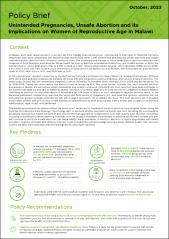
Unintended Pregnancies, Unsafe Abortion and its Implications on Women of Reproductive Age in Malawi
(APHRC, 2023-10)In Malawi, each year, large numbers of women die from illegally induced abortions, contributing to high rates of maternal mortality. Magnitude-wise, data compiled by Ipas Malawi reveals that in 2022 alone, 3,395 women and ... -
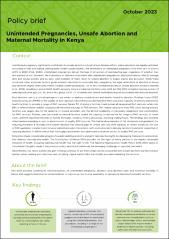
Unintended Pregnancies, Unsafe Abortion and Maternal Mortality in Kenya
(APHRC, 2023-10)Unintended pregnancy significantly contributes to unsafe abortion in much of sub-Saharan Africa, where abortions are legally restricted. According to the 2014 Kenya Demographic Health Survey (KDHS), the prevalence of ... -
Do Residents of the Slums of African Capitals Have Access to Cesarean Sections? The Example of Dakar (Senegal)
(Countdown to 2030, 2024)Physical and financial barriers to accessing cesarean section, which affect poor women more, are the main factors explaining high rates of maternal and neonatal mortality in low-income countries. To deal with this situation, ... -
Quality of Maternal and Newborn Health Services in Selected Urban Informal Settlement in Nairobi, Kenya,
(APHRCCountdown to 2030, 2024)Nairobi's rapid population growth and unregulated urbanization has led to an increase in people living in informal settlements. Lack of essential services has led to stalling maternal and neonatal mortality rates. While ... -
Working with Slum-Child Foundation to Address WASH Needs in Nairobi, Kenya
(ARISE Consortium, 2024)Supported by the ARISE Responsive Challenge Fund, the African Population and Health Research Centre worked with Slum-Child Foundation (SCF) to address water, sanitation and hygiene (WASH). Clean water often costs more in ... -
Working with Child Space Organization to Reach Children Heading Households in Nairobi.
(ARISE ConsortiumResearchGate, 2024)Supported by the ARISE Responsive Challenge Fund, the African Population and Health Research Centre (APHRC) worked with Child Space Organization to reach out to children heading up households in the attempt to address the ...