Parcourir Policy Brief par date de publication
Voici les éléments 1-20 de 94
-
Explaining educational disparities in Diourbel and Kaffrine.
(JSTOR, 2020)In Senegal, adolescents aged between 10 and 19 years, and young adults aged 20-24 represent 22.5% and 9% of the general population respectively (ANSD, RGPHAE 2013). Senegal is one of five countries globally with the lowest ... -
Insights from Kenya: How to keep children from poorer homes in School. Nairobi: Conversation Africa.
(The Conversation, 2020)It is widely recognised that education is a public good, which should be accessed by all, as a human right - irrespective of someone’s gender and socioeconomic or disability status. It is a goal that’s enshrined in the fourth ... -
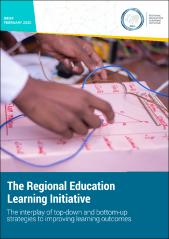
The interplay of top-down and bottom-up strategies to improve learning outcomes.
(APHRC, 2020)Top-down, bottom-up, and incremental approaches are usually applied to the implementation of policies (DarlingHammond, 2000). Top-down strategies refer to a more linear, unitary and rational process where decisions are ... -
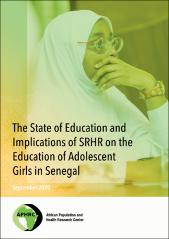
The State of Education and Implications of SRHR on the Education of Adolescent Girls in Senegal.
(APHRC, 2020)In Senegal, adolescents aged between 10 and 19 years, and young adults aged 20-24 represent 22.5% and 9% of the general population respectively (ANSD, RGPHAE 2013). Senegal is one of five countries globally with the lowest ... -
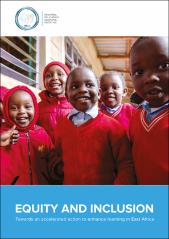
Equity and inclusion: Towards an accelerated action to enhance learning in East Africa (being designed). Briefing Paper. Nairobi: APHRC
(APHRC, 2020)Kenya, Uganda, and Tanzania are signatories to the national laws, regional and international conventions which reassert the role of the State to ensure the rights of children, particularly in education, are protected and ... -
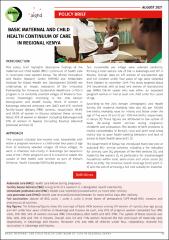
Basic maternal and child health continuum of care in regional Kenya.
(2021)This policy brief highlights descriptive findings of the maternal and child health (MCH) continuum of health care in rural/semi-rural western Kenya. The African Population and Health Research Center (APHRC) and Amsterdam ... -
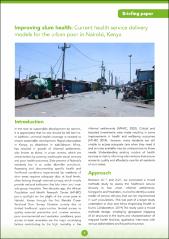
Improving slum health: Current health service delivery models for the urban poor in Nairobi, Kenya
(2021)In the race to sustainable development by nations, it is appreciated that no one should be left behind. In addition, universal health coverage is needed to ensure sustainable development. Rapid urbanization in Kenya, as ... -
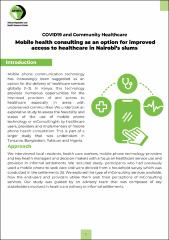
COVID19 and Community Healthcare Mobile health consulting as an option for improved access to healthcare in Nairobi's slums
(2021)Mobile phone communication technology has increasingly been suggested as an option for the delivery of healthcare services globally (1–3). In Kenya, this technology provides numerous opportunities for the improved provision ... -
COVID-19 and Human Rights: Perspectives and lived experiences of the Urban Poor in Kenya with regards to government COVID-19 response measures.
(2021)The COVID-19 outbreak, declared a pandemic by the World Health Organization (WHO) in March 2020, was first reported in China and has since spread across the globe. This sent the world into a state of panic. After the ... -
An in-depth insight into the household and healthcare financing in rural and peri-urban households in Kakamega and Kisumu
(2021)About 100 million of the world’s population is driven into extreme poverty due to ill health and lack of access to quality healthcare. Governments prioritize to ensure that the population accesses essential health services ... -
Lived experiences and pathways to abortion in Kilifi County, Kenya
(2021)Though teenage pregnancy rates have declined substantially, from 35% in 2018 to 13.4% in 2021, challenges surrounding the sexual reproductive health of adolescent girls and young women persist. -
Use of e-health programmes to deliver urban primary health-care services for noncommunicable diseases in middle-income countries.
(2021)While the County Department of Health routinely collects data on post-abortion care within the local health facilities, not much is known about unsafe abortions, and little evidence exists on the drivers of unsafe abortion, ... -
Deeper Divide: What Kenya’s Pandemic School Closures Left in Their Wake. Nairobi
(The Conversation, 2022)In Kenya, the pandemic disrupted learning for 15 million students in primary and secondary institutions. Schools closed on 16 March 2020, were partially reopened on 19 October 2020, and fully reopened on 4 January 2021. ... -
Evaluation of the Hygiene and Behaviour Change Coalition for COVID19 Prevention: Inclusion of Persons With Disabilities and Older People
(APHRC, 2022)This policy brief highlights the findings from an evaluation study on the inclusion of persons with disability and older persons in hygiene and behaviour change interventions implemented in Kenya during the height of the ... -
Synthesis Note: Tracing the Journey of the Development of the National Sanitation on Management Policy - Kenya 2022.
(APHRC, 2022)This synthesis note summarizes the process taken in developing the National Sanitation Management Policy (NSMP) in Kenya. It provides a brief background of how the process unfolded, describes the policy windows that were ... -
Kenya Multi-Site Integrated Serosurveillance Collaboration Policy Brief (High Prevalence of Antibodies Against COVID-19 Within the General Population: Evidence From Nairobi and Kilif).
(Gates Open Research, 2022)The Kenya Multi Site Serosurveillance (KEMIS) collaboration set out to implement an integrated, nationally representative, population-based program of serological surveillance for past infection for a number of important ... -
Kenya - National Adolescent Mental Health Survey (K-NAMHS) Key Findings. Nairobi, Kenya
(APHRC, 2022)Little is known about the prevalence of mental disorders among Kenyan adolescents. This is a critical gap in knowledge as studies have shown that mental disorders during adolescence, particularly those that remain untreated ... -
Food Systems Transformative Integrated, Policy: The Process, Enablers, and Barriers
(APHRC, 2022)The Food System Transformative Integrated Policy (FS-TIP) initiative supports governments that demonstrate robust integrative leadership and capacity for the development and implementation of transformative and integrated ... -
Impacts of COVID-19 Pandemic on Sexual and Reproductive Health Services in Uganda
(APHRC, 2022)This policy brief summarizes evidence from a cross-sectional survey conducted in Uganda to document the impact of COVID-19 pandemic on sexual and reproductive health (SRH) services. Data were collected from 543 women and ...